Calendar Reform Lessons Across Time

Time feels solid until someone tries to change it. A date on a document, a holy day, a market day, a harvest season, a tax deadline, a birthday, each one seems fixed because a community agrees to treat it that way. When that agreement shifts, people do not experience the change as a neat technical update. They feel it in wages, rituals, debts, memories, and the rhythm of ordinary life.
Calendar reform has always carried this tension. It promises accuracy, order, and a better match between civil life and the movements of the sun, moon, and stars. Yet it also asks people to trust a new system for measuring their days. That trust is hard to win.
The history of calendar reform offers more than a record of dates and decrees. It shows how societies handle change. England’s adoption of the Gregorian calendar in 1752 reveals the danger of poor communication and public suspicion. Late imperial China offers a different model, where several systems of time could work together rather than compete for total control. Broader histories of calendars show how inventive people have been in trying to give shape to time.
Taken together, these cases make one point clear: reforming time is never only about time. It is about authority, belief, habit, and the deep human need for continuity.

England learned that lost days can feel like stolen days
In 1752, England and its empire adopted the Gregorian calendar. This brought England into line with much of Catholic Europe, which had already made the switch after Pope Gregory XIII introduced the reform in 1582. The change corrected the drift that had built up under the older Julian calendar, whose year was slightly too long compared with the solar year.
The technical issue was simple enough. The calendar no longer matched the seasons as accurately as it should. The practical solution was much harder. England had to remove 11 days from the calendar. In September 1752, the day after September 2 became September 14.
To astronomers and officials, this was a correction. To many ordinary people, it looked like a loss.
Robert Poole’s Time’s Alteration: Calendar Reform in Early Modern England examines this moment with careful attention to the public mood. The famous claim that crowds shouted, “Give us our eleven days,” has been debated by historians, and it may have grown in later retellings. Yet the phrase survives because it captures a real anxiety. People feared that time itself had been taken from them.
That fear had several roots.
Many workers wondered what would happen to wages. If 11 dates vanished, would pay also vanish? Tenants and landlords worried about rents. Tax collectors had to adjust deadlines. Communities had to rethink fairs, court sessions, contracts, saints’ days, and anniversaries. Even when the law provided answers, the emotional problem remained.
A calendar is a public machine, but it runs through private lives. Change the machine, and every household feels the gears move.
England’s 1752 experience offers a lasting lesson for any reform effort: accuracy does not guarantee acceptance. A better system can still fail in public trust if people do not understand why the change is happening, how it affects them, and what protections are in place.
The reform also shows how quickly suspicion grows when ordinary people feel excluded from decisions. Calendar reform came from Parliament, scholars, and administrators. For many villagers, laborers, and small traders, it arrived as an order. That distance mattered.
A reform may be correct on paper and still feel hostile in practice.
Good reform makes the invisible visible
Calendar systems hide complexity. Most people do not think daily about leap years, solar drift, lunar cycles, or astronomical calculation. They rely on the calendar because it has already translated those details into usable dates.
This creates a problem for reformers. The reasons for reform often live in expert knowledge, while the effects land in common experience.
That gap shaped England’s response. The calendar’s drift from the solar year was not obvious in the way a broken bridge or failed crop was obvious. A scholar could explain it. A law could correct it. But the average person had to accept that an invisible error required a visible disruption.
This is why communication matters so much. Reformers need to make the hidden problem plain.
A useful reform message answers practical questions before rumors fill the space:
What is changing?
Why is the change needed now?
Who benefits, and how?
What happens to wages, debts, taxes, and contracts?
Which dates move, and which obligations stay the same?
Who can answer disputes?
Without answers, people supply their own. In 1752, talk of lost time, lost wages, and manipulated obligations spread because the change touched too many parts of life at once.
The deeper lesson is not that people resist knowledge. It is that people resist being asked to bear uncertainty for someone else’s promise of order.

Late imperial China shows how many kinds of time can coexist
England’s calendar reform centered on replacement. One calendar order gave way to another. Late imperial China presents a different picture, one in which multiple ways of measuring time could stand beside one another.
Fan Li’s Time as Norm: The Ritual Dimension of the Calendar Book points toward a world where the calendar was not merely a neutral schedule. It was a guide to ritual order, agriculture, governance, and celestial meaning. A calendar could tell farmers when seasonal shifts were expected. It could mark auspicious days. It could structure court ceremony. It could connect earthly rule to heavenly patterns.
This approach treated time as layered.
The solar year mattered for seasons and agriculture. Lunar cycles mattered for months and festivals. Ritual calendars shaped public and private acts. Celestial observation gave authority to the system, while local practice gave it life. These forms did not always merge into one clean sequence, but they did not need to.
People learned to move among them.
This is one of the most useful Calendar Reform Lessons Across Time. Reform does not always have to erase older systems. Sometimes it works better when it allows different temporal needs to remain visible.
Modern life already does this more than we notice. The United States uses the Gregorian calendar for civil dates. Religious communities follow liturgical, lunar, or lunisolar calendars for holy days. Schools run on academic years. Businesses use fiscal years. Farmers still pay attention to seasonal and ecological timing. Families remember anniversaries by personal meaning, not state decree.
No one lives by one clock alone.
Late imperial China helps challenge the idea that calendar reform must create a single total order. A society can recognize one civil calendar while still honoring other patterns of time. That does not mean every system fits easily with every other. Conflicts can arise. But coexistence can reduce the shock of reform because it does not demand complete surrender.
There is wisdom in leaving room for inherited rhythms.
Calendar books carried authority into daily life
A calendar is not powerful only because it names days. It is powerful because people use it to decide what to do.
In late imperial China, calendar books helped bring official and cosmic order into daily decisions. They did not simply record time. They shaped conduct. A day might be marked as favorable for one activity and unfavorable for another. Ritual timing mattered because it linked human action with larger patterns.
This gave the calendar a moral and cultural role. It helped define proper order.
That role differs from the modern assumption that calendars are mostly administrative tools. Today, many people think of calendars as grids on phones, work schedules, or printed pages on a wall. They are tools for coordination. In older societies, calendars often carried a broader meaning. They connected agriculture, religion, kingship, astronomy, and personal conduct.
This matters because reformers often underestimate attachment. People may not defend an old calendar because they love technical inaccuracy. They may defend it because it carries memory, identity, or ritual meaning.
For example, changing the official date of a festival may seem harmless to an administrator. To a community, it may break a chain of inherited practice. Adjusting the start of a year may help tax offices, but it can unsettle the symbolic order of civic life. Moving feast days, market days, or legal terms may force people to rethink how their lives are organized.
A calendar can look like a table of dates. In practice, it is closer to a shared language.

World calendar histories reveal a long record of experiment
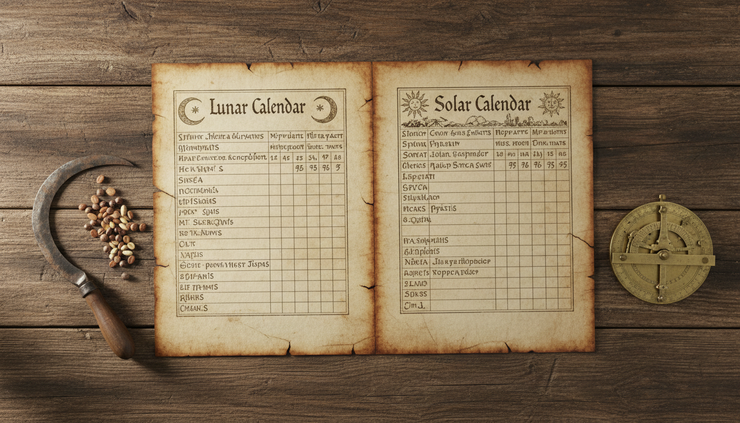
M. Agzamova’s The Evolution of Time: A Journey Through the History of Calendars invites a wider view. Across cultures, people have used many systems to measure time, including lunar calendars, solar calendars, and lunisolar calendars that try to reconcile both.
Each system solves one problem while creating another.
A lunar calendar follows the moon’s phases closely, which makes months feel visible in the sky. Yet a purely lunar year does not stay aligned with the solar seasons. A solar calendar tracks the year’s seasonal cycle more closely, but its months are less tied to the moon. Lunisolar calendars attempt a balance by adding extra months when needed, but they require careful rules.
These choices reveal different priorities. A farming society may care deeply about seasonal alignment. A religious community may center ritual cycles. A state may seek administrative regularity. Merchants may need predictable dates across regions. Astronomers may press for mathematical precision.
No calendar is innocent of values. Every calendar answers the question, “What kind of order matters most?”
History is full of attempts to improve that order. The Julian calendar simplified Roman timekeeping but slowly drifted from the solar year. The Gregorian reform corrected that drift through revised leap year rules. Other cultures developed systems grounded in local observation, imperial authority, religious tradition, or mathematical astronomy. Some reforms endured. Others faded because they failed to fit daily life.
The pattern is familiar. Technical elegance can attract reformers, but social use decides survival.
A proposed calendar may offer equal quarters, fixed weekdays, or cleaner accounting. Yet if it disrupts worship, pay cycles, national holidays, or family customs, it faces resistance. People do not live in abstract time. They live in meals, markets, school terms, planting seasons, mourning periods, and celebrations.
A successful calendar must be usable before it can be admired.
Reform works best when it respects habit
Reformers often focus on defects in the current system. That is understandable. Without a defect, there is no case for change. But people rarely judge a calendar only by its defects. They judge it by familiarity.
Habit has real value. It reduces friction. It helps people plan without thinking through every rule. It lets communities share expectations. Even an imperfect calendar can function well if people trust it and know how to use it.
This does not mean old systems should never change. The Gregorian reform did solve a real astronomical problem. Many calendar reforms have improved coordination across regions and institutions. The point is that reform needs more than a correct formula.
It needs a path for adoption.
That path usually includes three kinds of care.
Care for explanation
People need a clear reason for the change. The reason should connect expert knowledge to ordinary life. If the issue is seasonal drift, show how it affects holidays, agriculture, or long-term planning. If the issue is legal consistency, explain what confusion the reform prevents.
Care for transition
A calendar change affects deadlines, pay, records, and memory. Reform should protect people from unfair loss. Transitional rules should be simple and public. When possible, old and new dates should appear together for a period of time.
Care for meaning
Dates carry emotion. Reformers should treat rituals, festivals, and anniversaries with respect. If a reform touches sacred or communal days, leaders from those communities need a voice in the process.
The mistake is to treat resistance as ignorance. Sometimes it is. More often, it is a signal that reformers have failed to see what the old system was doing for people.
The lasting lesson is patience with lived time
The stories of England, late imperial China, and wider calendar history do not give one simple rule for reform. They give a more demanding lesson: time is both mathematical and human.
England in 1752 shows the danger of imposing a new order without enough public trust. The reform corrected a real problem, but the missing days became a symbol of unease. People wanted to know whether their labor, debts, rents, and memories would be honored.
Late imperial China shows that calendars can hold more than one kind of time. Civil order, ritual practice, agriculture, and celestial observation can overlap. A new system does not always need to destroy the old one.
Global calendar history shows that humans have never stopped experimenting with time. We have watched the moon, tracked the sun, inserted leap days, added months, renamed years, and argued over beginnings. Every solution reflects a choice about what a society values.
The best reforms begin with humility. They recognize that a calendar is not just a measuring device. It is a social agreement, a ritual guide, a legal tool, and a keeper of memory. Change the calendar, and people will ask a fair question: what happens to the life we built around it?
Good reform answers that question before it asks for trust.


Comments